
Deep within the Church of the Holy Sepulchre in Jerusalem lies a chapel commemorating the discovery, or “Invention,” of the Cross.
In Latin, invenire simply means “to discover” or “to find.” The Chapel of the Invention of the Cross, therefore, commemorates the discovery of the True Cross by Saint Helen.
From the beautiful Armenian Chapel—formerly the Chapel of Saint Helen—the visitor descends via a stone staircase.
As the visitor descends, the masonry walls—on which pilgrims of old carved crosses—give way to the pinkish-orange limestone of the bedrock. Let us not forget that the site of the Holy Sepulchre was a very ancient stone quarry that had been converted—as early as the time of Jesus—into a necropolis.
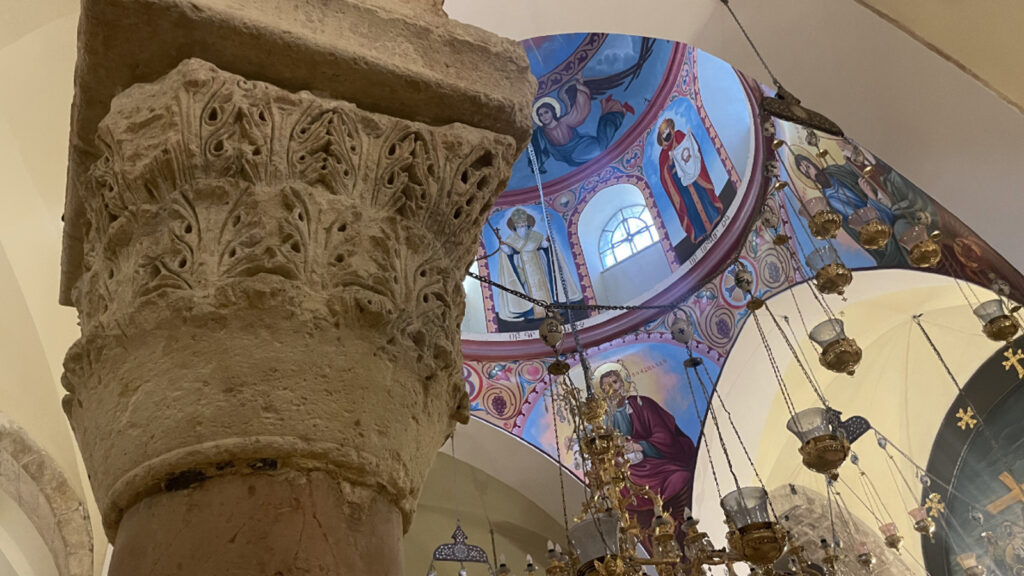
Crusader dome of the Armenian chapel of St Gregory, also known as the chapel of St Helen. Henri Gourinard, 2026.
A mound of poor-quality rock was used for the public executions due to its proximity to the city gates: this is Golgotha (the Place of the Skull or Calvary). The titulus crucis, the sign that Pilate had affixed to the top of the cross, bearing the reason for Jesus’ condemnation in Latin, Greek, and Hebrew—could indeed be read by the passersby (see John 19:20).
At the opposite end, the lower levels of this same quarry were reportedly used to store the crosses that had been used in the executions.
Socrates, a 5th-century Byzantine author tells us that it was in this deep place that Saint Helen, mother of Emperor Constantine, identified the True Cross of the Saviour. According to this same source, she had a paralysed woman laid upon the crosses found there. Upon coming into contact with the True Cross, the woman was reportedly healed.
It should be noted that this anecdote is absent from Eusebius of Caesarea’s account of the construction of the Holy Sepulchre, as recorded in his Vita Constantini. But it is also true that Eusebius seems to systematically downplay the role played by Helena in the discovery of the relics, thereby elevating that of her son Constantine in the construction of the sacred edifice.
In any case, the tradition quickly gained popularity among the public in Jerusalem and beyond, so much so that in the 12th century, the Crusaders dedicated the two abovementioned chapels.
Empress Helena seems conspicuously absent from the chapel that bears. Armenians have chosen instead to honour their own national traditions regarding their people’s conversion to Christianity, which took place a few years before Constantine himself issued the Edict of Milan (313).

The Franciscan Chapel of the Invention of the Holy Cross with the statue of St Helen embracing the Holy Cross she had just discovered. Note the crosses carved by medieval pilgrims to the right. The bedrock of the ancient quarry serves as a natural vault to the chapel. Henri Gourinard, 2025.
Nevertheless, among the paintings that adorn its walls, one of them depicts not the discovery of the True Cross, but its triumphant return to Jerusalem after the Persians had stolen it following their invasion of Jerusalem and the eastern provinces of the empire in 614. Emperor Heraclius, after miraculously turning around a military situation deemed hopeless and securing a decisive victory over the Persian Empire, organised his triumphal return to Jerusalem, which took place on September 24, 629 (see the article on the Golden Gate). This is the date of the Solemnity of the Exaltation of the Cross in the liturgical calendar.
In fact, as early as the 4th century, the Church of Jerusalem commemorated the Glorious Cross on this same day—or, more precisely, on September 13—the anniversary of the dedication (Encaenia) of the Church of the Anastasis (“Resurrection” in Greek), which in the West is known as the Church of the Holy Sepulchre, and which took place in 335. In fact, the pilgrim Egeria informs us that the day of this dedication had been set precisely on the day when Saint Helena (whom she, alas, fails to mention) had discovered the relics of the True Cross.
Coincidence or providence? Two events related to the Holy Cross took place on the same dates, September 13 and 14.
By Henri Gourinard