
It seems like the Basilica of the Holy Sepulcher is constantly under construction. About ten years ago, the Edicule of the Lord’s Tomb was completely renovated; now the time has come to redo the floor.
One must acknowledge that both the history and the topography of the site lend themselves perfectly to this cycle of construction, destruction and renewal. The church was built over an ancient quarry that had already been abandoned in the time of the Lord and turned, in part, into a place of execution for the condemned – Golgotha – and, in part, into a garden-cemetery the Sepulcher itself.
Thus, when Saint Helena arrived in Jerusalem at the beginning of the fourth century, it was deep down – in the very bowels of this ancient quarry – that she found the True Cross on which the Saviour of the world was nailed. Tradition tells us that the place had previously been transformed into a temple dedicated to Jupiter Capitolinus and the goddess Venus. Constantine’s architects covered the site with rubble so as to erect above it a great basilica – known as the Martyrium, according to the pilgrim Egeria.
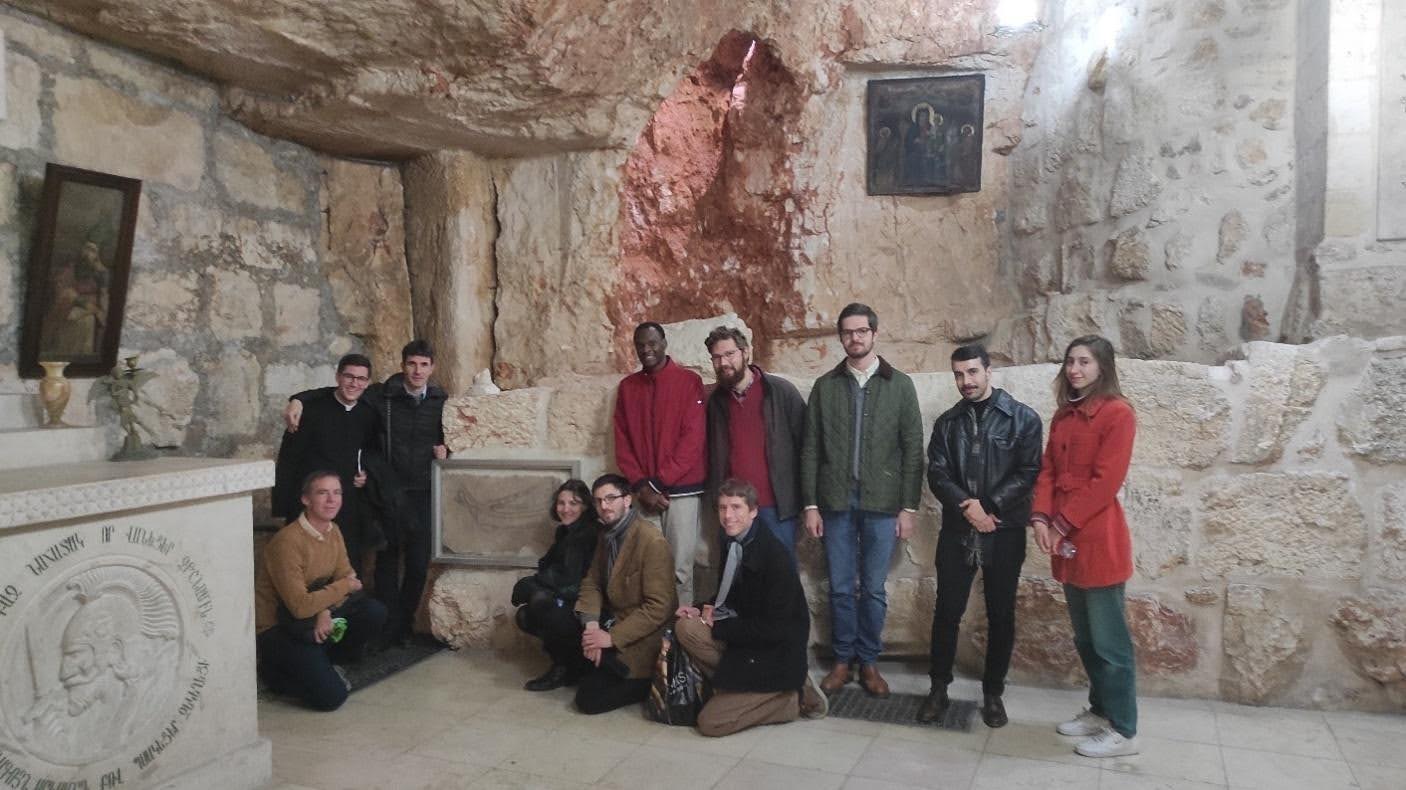
It was the Crusaders who, in the twelfth century, reopened the depths of the Holy Sepulcher by creating the chapels of Saint Helena and the Invention of the Holy Cross. The latter was the deepest place in the entire basilica until the 1970s, when the Armenian Church wanted to determine whether the space east of the Chapel of Saint Helena (Saint Gregory for the Armenians) was empty or not. They discovered the natural vault of the rock of the ancient quarry, some cisterns, and open spaces intersected by ancient walls. In one of these spaces an enigmatic graffito was found.
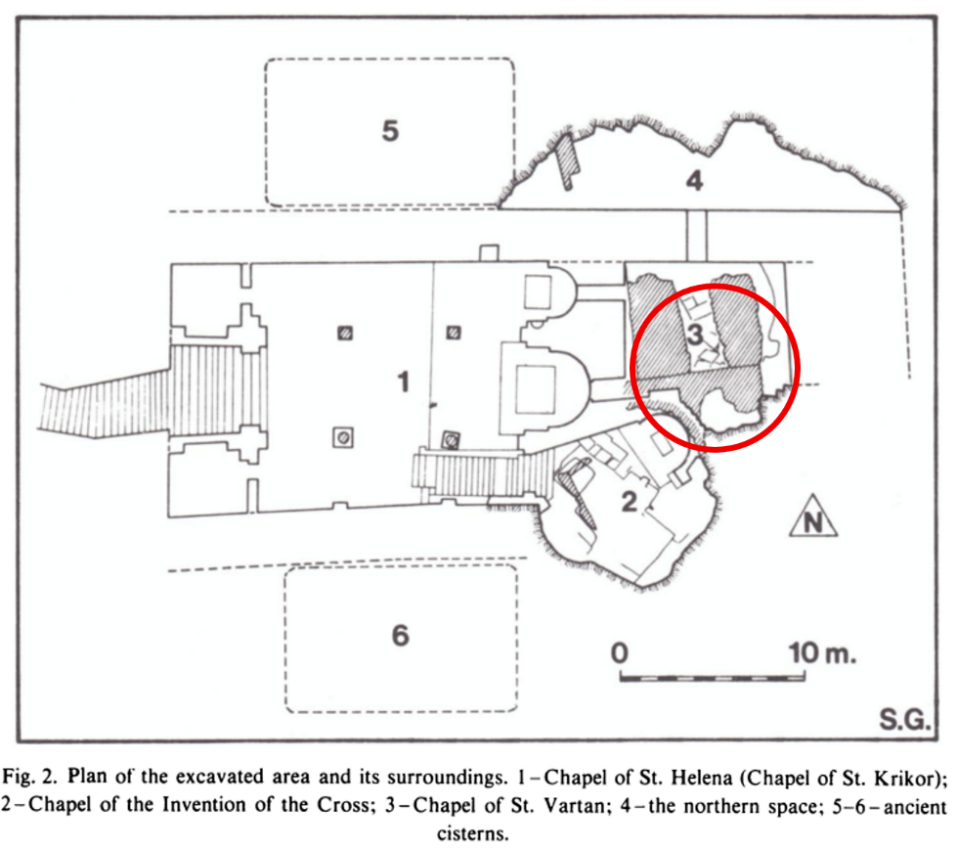
The red circle marks the chapel of Vartan. Source: Source: Broshi, M. and Barkay, G., “Excavations in the Chapel of St. Vartan in the Holy Sepulchre”, Israel Exploration Journal 35, no. 2-3 (1985), p. 110.
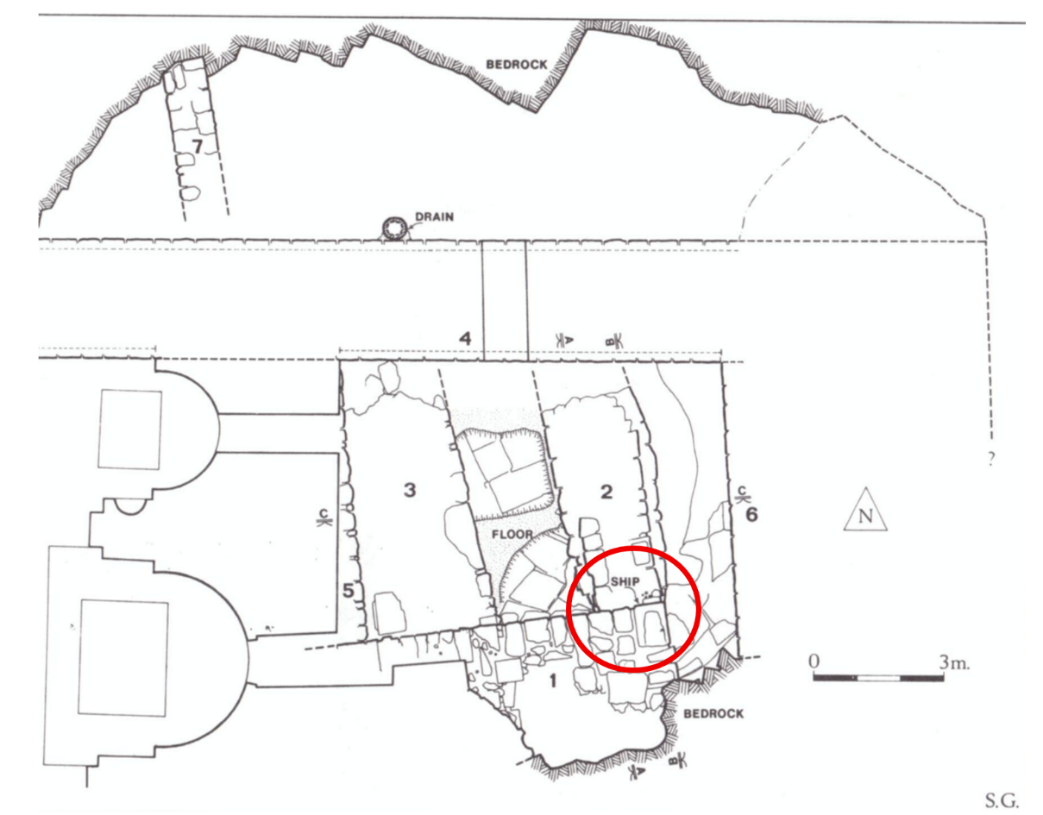
Plan of the excavations of the Chapel of Saint Vartan. The ship drawing (within the red circle) was found at the eastern end of Wall 1 (wall of the temenos of Hadrian’s temple). Source: Broshi & Barkay (1985), p. 120.
The graffito depicts a ship with a quarter rudder. The prow is on the left and the stern on the right. The sails have been lowered and the mast laid down. Could it have suffered through a storm?
Another enigmatic point is the inscription. It reads in Latin: DOMINE IVIMUS. The form ivimus does not exist in Latin for the verb ire (to go). The closest forms are ibimus (we shall go) or imus (we went). If its author was a Christian, it is possible that he drew inspiration from the first verse of Psalm 121 (Vulgate). Psalm 121 belongs to the genre of the Songs of Ascents sung by Jewish pilgrims on their way to the Temple of Jerusalem. The psalmist begins with a cry of joy: Laetatus sum in his quae dicta sunt mihi: in domum Domini ibimus (“I rejoiced when they said to me: ‘We shall go to the house of the Lord’”). What interests us is the second part of the verse: in domum Domini ibimus.

To preserve it better, the famous inscription has been placed under glass. The prow of the ship is on the left and the stern on the right. Note the double steering oar. If the author of the graffito respected the proportions more or less, it would be a modest merchant ship typical of the Roman Mediterranean. Photo: Henri Gourinard.
The fact that the ‘b’ of ibimus has been transcribed as ‘v’ indicates, according to some specialists, the Hispanic origin of the author of the graffito. Does not the Latin saying go: Beati Hispani quibus vivere bibere est (“Blessed are the Spaniards, for whom to live is to drink”)?
The text of the inscription may have another inspiration: the words of Peter addressed to Jesus after the discourse on the Bread of Life, recorded in the Gospel of John (6:68): Domine, ad quem ibimus? (“Lord, to whom shall we go?”). Both the vocative case of “Lord” (Domine) and the future tense of the verb “to go” (ibimus) coincide with the text of the graffito, but the omission of “to whom” (ad quem) makes the reading of the inscription rather weak, not to say incomprehensible.
A third interpretation would get us out of the difficulty: Domine, imus (“Lord, we have arrived”): a simple spelling error – a ‘v’ inserted between the two ‘i’s of the verb ire conjugated in the first person plural past tense.
With this inscription and this drawing of a ship with its sails lowered, the author simply wished to express his gratitude, and that of the entire crew, to the “Lord” (Jesus Christ or Jupiter Capitolinus?) for having saved them from shipwreck. If they were Christians, we are faced with the first archaeological evidence of pilgrims visiting the site of the Holy Sepulcher before Helena and Constantine erected the great basilica of the Anastasis.
By Henri Gourinard