
The image of the church of the Holy Sepulchre closed has been shocking for christians in Jerusalem and around the world. The only ones inside are the Franciscan, Orthodox and Armenian religious communities that live there and have celebrated the liturgy of these feast days without people. The last time this happened was in the 12th century, when sultan Saladino reconquered Jerusalem and closed the Holy Sepulchre with the religious communities of the different christian creeds inside.
This year, Holy Week has been very unusual for all due to the confinement situation of this sanitary crisis of Covid 19. Traditions and ceremonies typical of these days in many countries didn’t take place and the faithful needed to accept that they could only follow the religious celebrations online. In Jerusalem, the franciscans of the Custody of the Holy Land, celebrated behind closed doors the liturgy of these days in the Holy Places.
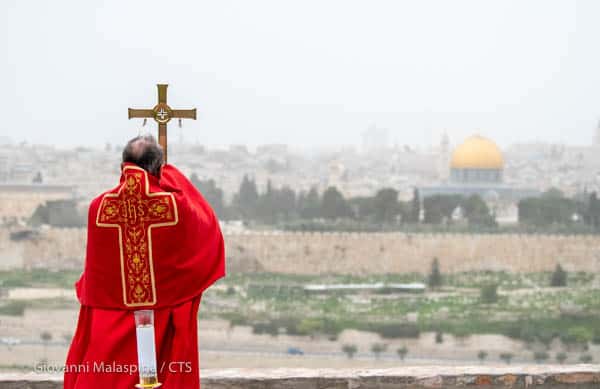 On Palm Sunday, the Apostolic Administrator of the Latin Patriarchate of Jerusalem, Mons. Pierbattista Pizzaballa, presided the mass behind closed doors in the Holy Sepulchre together with some friars and seminarists. In the afternoon, he went to the sanctuary of Dominus Flevit, in the Mount of Olives. There, Mons. Pizzaballa said a special prayer, accompanied by some of the local clergy, and he blessed Jerusalem with a relic of the Holy Cross. All of this could be followed by the faithful on streaming.
In an interview, the Apostolic Administrator acknowledged that there was a beautiful aspect of the situation, because everything is calmer and the rhythm is slower, so “you can enjoy prayer in a deeper way”. However, he felt sorry for the people, because the Eucarist without the christian community is a “broken” celebration.
On Holy Wednesday, in the Holy Sepulchre, the Franciscan community of friars followed the ancient tradition of venerating the Column of the Flagellation, in which Jesus was scourged. Meanwhile, the community in Gethsemane celebrated that same day the mass singing the Passion. In both cases, the faithful could not attend as they used to do other times.
The same happened with the celebrations on Holy Thursday. During the Holy Hour in Gethsemane, the Custos of the Holy Land, Fr. Francesco Patton, highlighted: “We know that at this particularly difficult time for the whole of humanity, many of our brothers, like Jesus on the night of the first Holy Thursday, are experiencing anguish, are sweating blood and are living the hour of their agony, of their fight to continue trusting the Father and to put themselves totally in the hands of the Father, just like Jesus and together with Jesus. We also pray, with Jesus: “Abbà! Father! Everything is possible for you. Take this cup from me! Yet not what I will, but what you will” (Mark 14,36).

The Easter Vigil on Saturday in Jerusalem is the first one across the globe, because it is celebrated at 8 am due to an ancient tradition that is preserved by the Statu Quo. It is considered the “mother of all Holy Vigils”. On Sunday, Mons. Pizzaballa commented on his homily of the Easter Mass:
“Not being able to celebrate salvation, during this Holy Triduum, in this atmosphere of fear and uncertainty, has made us even more aware of our fragility and our limits (…) Yet, in this time of great difficulty and loneliness, perhaps we take the words Martha said to Jesus more as our own: “Lord, if you had been here, my brother would not have died!” (John 11,21). How this loneliness weighs on us, how difficult it is to be guided by Him on these unknown paths! Well, here, facing this empty tomb, we now want to cry out: Lord, you have not abandoned us in the arms of death. The tomb is empty. You are no longer in the tomb, because we know that You Lord are alive and are here, with us. Your love sustains us, lights up our existences and comforts our fragile hopes.”
You can read more here.
