
Traveling to the Holy Land is much more than sightseeing: it means walking through the places where the life of Jesus Christ and the history of salvation unfolded. But like any pilgrimage, it’s worth preparing well so that logistics don’t take away from the experience.
Documentation, security, climate, clothing, and transportation work differently than what you may be used to in other destinations, so this guide brings together the practical matters worth sorting out before leaving home, no matter which country you’re traveling from, so that once you’re there, all you have to worry about is living the trip.
Before flying to the Holy Land: what to have ready
The logistics start right at your departure airport. Arrive at least 4 hours early, since security checks for flights to Israel are stricter than for other destinations.
It’s also worth keeping the country’s weekly rhythm in mind: Shabbat halts transportation and much of the commerce from Friday sunset until Saturday night.

Security and border control
Both when entering and leaving through Ben Gurion Airport you’ll go through a security check more thorough than at other airports: you’ll be asked detailed questions about your itinerary, where you’ll be staying, and the purpose of your trip. Answer calmly and honestly, and keep your hotel and flight booking documents on hand to speed up the process.
One detail that often surprises first-time travelers: your passport is no longer stamped on entry. Instead, you’ll be given a loose blue card, the Border Pass. It’s a small piece of paper that’s easy to lose, so keep it safely inside your passport, as you’ll be asked for it again when you leave the country.
Documents and visa for traveling to the Holy Land
Entry regulations for Israel changed recently, so it’s worth checking them ahead of time and not assuming anything even if you’ve traveled there before: as of January 1, 2025, every traveler needs a valid visa or ETA-IL approval before starting the trip.
The specific requirements — whether you need to apply for the ETA-IL online or apply for a visa at an embassy or consulate — depend on your nationality, so it’s worth checking in advance on the official immigration website for the country you’re traveling from; leaving it until the last minute can complicate your departure.
Along with your visa, make sure the rest of your travel documents are in order:
- Passport valid for at least 6 months after the date you leave Israel.
- Travel medical insurance, especially recommended given how intense the pace of a pilgrimage usually is.
When to travel: the climate in the Holy Land
The climate has a direct impact on how you experience each day of the pilgrimage, since much of the route is covered on foot and outdoors. Summers are dry and hot, ideal if you’d rather avoid rain but demanding in terms of heat.
Winters, on the other hand, are mild, with brief but intense rains, so it’s worth packing for them. Spring and autumn offer a middle ground: high daytime temperatures that drop noticeably at night, so layered clothing is your best ally during these seasons.
Whatever time of year you travel, if you get hot weather, pay special attention to staying hydrated and protect yourself with sunscreen, sunglasses, and something to cover your head.
What to pack for the Holy Land
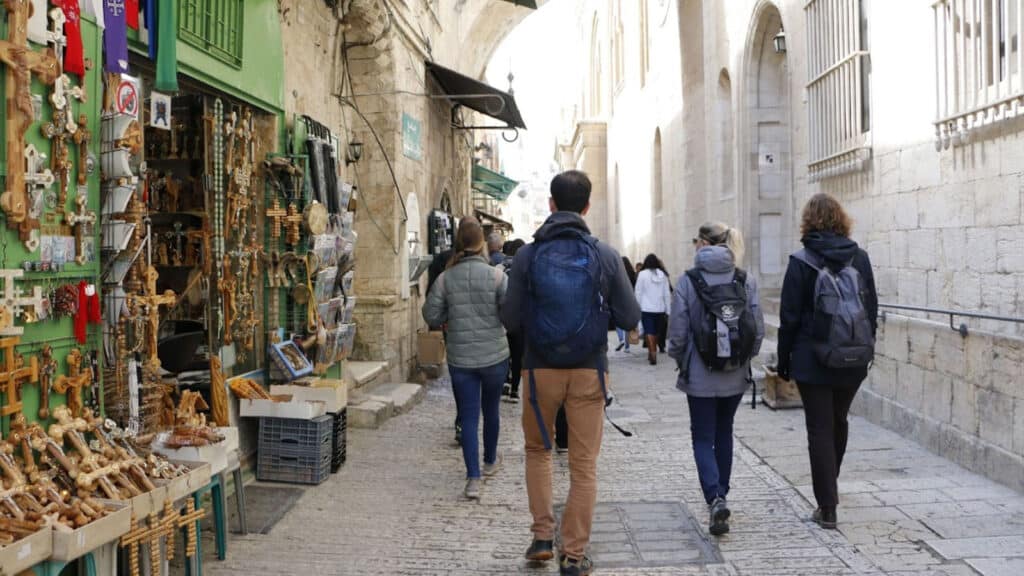
When packing, think about comfort and respect for the places you’ll be visiting:
- Comfortable shoes: a pilgrimage through the Holy Land involves many hours of walking, between Holy Cities, archaeological sites, and getting around on foot, so this is a key item in your suitcase.
- Appropriate clothing for the Holy Places: both men and women must cover their shoulders and knees to enter them, a rule strictly enforced at temples and shrines, so it’s best to plan for it while packing.
Money and currency in Israel
The local currency is the New Israeli Shekel (NIS). It’s not essential to exchange large amounts before traveling, since tourist areas readily accept major international currencies, such as the euro or the US dollar, as well as most credit cards.
Still, it’s a good idea to carry some cash in shekels for small expenses, tips, or small local shops where card payment isn’t always convenient.
Language in the Holy Land
Not speaking the local language shouldn’t be an obstacle for your trip. The most widely spoken languages are Hebrew and Arabic, but English is widely spoken, especially in tourist areas: you’ll find signs, receipts, and menus in English too, which makes daily life much easier for pilgrims.
Getting around the Holy Land
Getting around the Holy Land with ease will help you make the most of each day of your pilgrimage. To check train schedules, the official Israel Railways website is your main reference, and to access public transportation in general you’ll need the Multi-line travel ticket, the card used to pay for buses and trains.
Two apps will make your trip much easier: Moovit, for checking public transport routes in real time so you don’t get lost along the way, and Gett, for booking taxis safely when public transport doesn’t reach your destination or you simply want to get there faster.
Keep in mind the effect of Shabbat on your travels: Israeli public transport shuts down completely during the Jewish weekend. Far from being an inconvenience, you can use those days to explore Jerusalem’s Old City on foot, at a calm pace and without the usual bustle, or head to Arab areas like Bethlehem or Nazareth, where transportation continues to run as normal.

Get your “pilgrim mode” ready
Beyond logistics, it’s also worth preparing for the trip on the inside. Arriving in the Holy Land with some prior reading completely changes the way you experience each place: recognizing a Gospel passage as you stand where it happened is a very different experience from visiting it without that context.
At Saxum, we recommend the book In the Footprints of Our Faith and the videos on our YouTube channel as a starting point, although you’ll find many more resources online to go deeper before leaving home.
During the trip itself, the pace of a pilgrimage — with transfers, schedules, and large groups — makes finding moments of silence quite a challenge. Still, it’s worth seeking them out deliberately: they’re the moments you’ll remember most clearly afterward.
Bringing a pocket Bible with you, whether in print, ebook, or on your phone, is a simple way to always have on hand the text that gives meaning to what you’re seeing, turning every stop into a moment of prayer as well as a visit.
Useful links
Emergency phone numbers in Israel
- Police: 100
- Ambulance (Magen David Adom): 101
- Fire department: 102
- Missing persons: 105
Some recommended museums in the Holy Land
Enrich your Holy Land experience
With the logistics sorted and “pilgrim mode ON,” you now have everything you need to prepare your trip with peace of mind and focus your energy on what really matters: the experience.
If you’d also like to gain a deeper understanding of the biblical message of the Holy Land before exploring it, we invite you to include a visit to Saxum Visitor Center, just minutes from Jerusalem, as part of your pilgrimage itinerary.