
On June 24, 2025, Pope Leo XIV confirmed the election of our brother, Fr. Francesco Ielpo, OFM, as Custos of the Holy Land and Guardian of Mount Zion.
What is the Mission of the Franciscan Custody in the Holy Land?
The mission of the Franciscans in the Holy Land dates back to the time of Saint Francis of Assisi. In 1217, during the Fifth Crusade, Saint Francis sent the first friars to this land.
Two years later, Francis himself came to the region as a pilgrim of peace. During that journey he met the Sultan Al-Malik al-Kamil of Egypt — a historic encounter that became a powerful symbol of dialogue and peace.
From that moment on, the Franciscans remained in the Holy Land. Gradually they began caring for the holy places. The first site entrusted to them, with the support of the King of Naples, was the Cenacle, where the first Franciscan convent was also built.
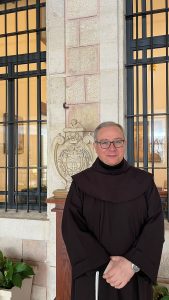
Franceso Ielpo, Custos of the Holy Land, Monastery of St. Saviour, Jerusalem 2026
Later, other important shrines were entrusted to their care, including the Church of the Holy Sepulcher and the Church of the Nativity.
In 1342, Pope Clement VI formally entrusted the Franciscans with the custody of the holy places, establishing the mission that continues to this day.
But caring for the holy places soon meant more than protecting sacred stones. It also meant caring for the “living stones” — the local Christian communities.
Today the Custody is responsible for:
- Around 50 shrines and holy sites
- 24 parishes
- 18 schools totaling around 10,000 students (both Christian and Muslim)
- Cultural and educational centers
- the Studium Biblicum Franciscanum
- Houses for pilgrims
The presence of the Custody extends across several countries: Israel, Palestine, Jordan, Lebanon, Syria, Cyprus; as well as the Greek island of Rhodes. Today, about 300 Franciscans serve in this mission.
The Situation of Christians Today
“The situation is very difficult,” Fr. Ielpo explains. In the West Bank the situation is particularly challenging. Many Christian families depend on religious tourism for their livelihood. After the impact of COVID-19 and now more than two years of conflict, many families face serious economic difficulties.
The Church and the Custody try to help through charitable initiatives, schools and community support, but the needs are great.
In Israel, Christian communities also live with constant tension and uncertainty about the future of their children.
Yet the mission of the Church remains clear.
“Our presence here witnesses another Presence,” Fr. Ielpo says. “Our presence witnesses the presence of God among His people.”
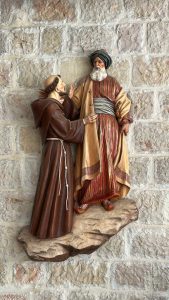
Saint Francisof Assisi, the Pilgrim of Peace, and the Sultan in Egypt
A Message of Hope from Jerusalem
Fr. Ielpo uses a powerful image from the Gospel to describe the current situation. “The Church today is like the boat in the storm on the Sea of Galilee. The storm is strong, but Jesus is in the boat. And with Him, everything is possible.”
He reminds us that the Holy Land is both the land of the Passion and the land of the Resurrection.
“In this darkness there are many points of light. Our mission is to show those points of hope and resurrection.”
Why Pilgrimages Still Matter ?
Fr. Ielpo highlights two reasons why pilgrimages to the Holy Land remain essential.
First, for the pilgrim.
A pilgrimage to the Holy Land can be a transformative spiritual experience. Many pilgrims say that their lives are divided into before and after their pilgrimage.
Second, for the local Christian communities.
The presence of pilgrims brings not only economic support, but also encouragement and hope to the local Christians.
“When the shrines are full of pilgrims,” he says, “the local Christians understand that their mission is to remain here and preserve the holy places. You understand that you have a mission in your life.”
The Role of Young People
Young people are essential for the future of the Church and society. Education is therefore a central priority for the Custody through its schools and educational institutions. But education must go beyond academics. “We must help young people keep their hearts free from hatred,” Fr. Ielpo says.
The future will depend on forming new generations in dialogue, respect and openness.
How the World Can Help?
Fr. Ielpo suggests several ways people around the world can support the mission of the Custody.
First: prayer.
Second: pilgrimage.
He also encourages people to learn about the reality of the Holy Land. “Read, learn, understand what happened here,” he says.
And of course, donations and material support can also help sustain the many projects of the Custody.
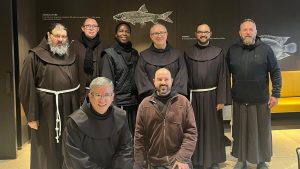
Custody of the Holy Land, at Saxum Visitor Center 2025
A Favorite Place to Pray
Among the many holy places, Fr. Ielpo especially loves praying by the Sea of Galilee, near Capernaum. “There you can contemplate the ordinary life of Jesus,” he says.
“Our God is a God who enters our daily life — not only at extraordinary moments, but throughout the ordinary moments of life.”
A Gospel for Our Time
My favorite Evangelists is Mark, because he is simple and direct. In this period of uncertainty, Fr. Ielpo reflects on the parable of the Sower.
“This is the time to spread the seed with generosity,” he explains.
“We should not worry too much about the results. Our mission is to go out and sow the seeds of hope.”
Encountering God
Finally, Fr. Ielpo reflects on how we encounter God. “God is always found through an encounter with another person,” he says.
He recalls a phrase from Pope Paul VI: “Today the world needs not so much teachers as witnesses.” Pope Paul VI.
By Blanca Ramirez, Manager Saxum Visitor Center