
His Beatitude Card.Pierbattista Pizzaballa Latin Patriarch of Jerusalem shared with us his life experience in the Holy Land.
Where is your favorite place to pray in the Holy Land?
It depends on how I feel, sometimes Gethsemane, sometimes the sea… Where I always feel at peace is the Sea of Galilee, but far from people, alone in silence, where there is no human interference or noise.
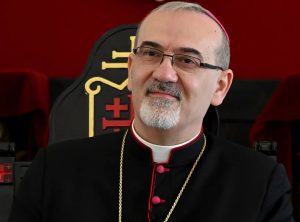
Cardinal Pierbattista Pizzaballa, the Latin patriarch of Jerusalem
Do you rest somehow? Do you have a hobby?
Resting now is a difficult word. There is not much time, especially in this period.
My hobby is reading. I like to search in “Accordance,” a Bible software. I organize, ask questions about the Bible, about the ancient languages and I use my early morning to look for, to investigate Bibles, especially the Old Testament.
And, also music, especially Bach: Nulla dies sine Bach, no day without Bach.
What is your favorite prayer?
I don’t have a favorite prayer. I like the prayers of St. Francis—of course, it is in my formation—especially the “Lodi del Dio Altissimo” [Praises of the Most High God]. If you pay attention, there is progress in his prayers. In the first prayers, the pronoun “I” is present. In the last prayers of the life of St. Francis, there is no “I,” just “You.” And I like this. In his last prayer, “Lodi del Dio Altissimo,” it’s only “You, You, You” to God. This is what I like.
And then, of course, to read the Psalms, the Bible, especially the Old Testament.
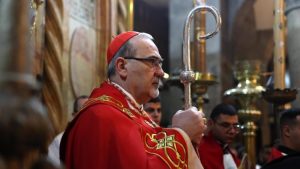
Card. Pierbattista Pizzaballa at the Holy Sepulcher
How can we live tolerance and patience with those who think differently from us?
Tolerance is not the right word; it is a negative word. In modern Hebrew tolerance is sōvlanut. The etymology is from saval which is to bring on the shoulder, but also to suffer, something negative, heavy for you.
How to deal with the opinion of people that think differently from us? First of all, the difference is necessary. We are created free and the fruit of freedom is our difference and diversity. If we all think the same, we are like Babel, where there was one world and one language. It’s the first ideology of history, “il Pensiero Unico” [the single thought]. It is in Genesis 11. In Genesis 10 there is the list of the tribes and the languages, but Genesis 11 starts saying that all the people spoke one word and one language. So, the opposite. When God destroyed Babel, destroyed that new order, where there were no differences in languages. And in Pentecost, where we read the list of different languages, we see the fulfillment of Babel: the different languages remain, but they understand each other. Diversity and difference are necessary because they are the fruits of freedom. The devil doesn’t want diversity and imposes uniformity. We need to work for unity, not uniformity.
How to deal with this? First of all, we have to be aware of one thing. Diversity is important. We have to distinguish diversity from violence. We have to respect the different opinions, we cannot accept the imposition, the use of violence and to deal with the diversity in a violent way, because behind this is the devil, the desire to impose one opinion. We have to be very clear, candid, and honest, to respect diversity, and to expect to be respected. The freedom of others is also my freedom.
And to be clear in things that Catholics forget sometimes: that there is evil, there is desire of possession, there is also the choice of evil. On this, we have to be very tough: I respect the diversity, I respect the difference, those who think differently, but to respect doesn’t mean to accept what is evil.
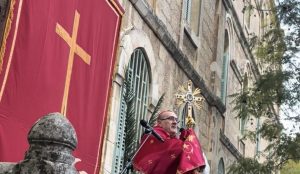
Card. Pierbattista Pizzaballa during the Holy Week 2025
Do you have friends from other religions?
Yes, I have. These times are difficult. Some friendships are now wounded, others stronger, depending on how they deal with the situation. My position doesn’t help, first of all because friendship needs time. And friendship needs, especially nowadays, dialogue, discussion, to be frank, and that is not always possible.
A message to the youth, for the young people, especially for those who are looking for something.
There are many things I can say to them, but an important one is this: Don’t look outside for what you have to find inside.
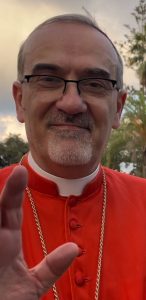
Card. Pierbattista Pizzaballa in Jerusalem
Do you have any favorite Gospel passages?
It depends on the moments because we are not robots and a passage that said nothing in the past, now can have light. In this period, as I have said in some homilies, there is this Beatitude: “Blessed are the meek, for they will inherit the earth.” We are living in a period of the world when power and strength decide. Which is an illusion. What matters is what those who are meek build: from the cultural point of view, the arts, and all things in life, the relationships, the families, are the fruit of what the meek build on Earth.
The other Beatitudes talk about the heavenly kingdom; this one talks about the Earth. Now, we think that the big powers will decide the future of the world but that is not true. We don’t remember who the great powers were thousands of years ago; they are all lost and everything that they did is over. But we do remember who Saint Francis or Saint Benedict were. All that was built by the small ones, with meekness and love, is still here.
Thank you for your time. We will stay united to your prayers
By Blanca Ramirez, Saxum Visitor Center Manager