
In the feast of Passover, the salvation of the people of Israel is relived—the people held captive in Egypt—when the destroying angel passed over the houses of the Hebrews and struck down mortally only the firstborn of the Egyptians.
According to the official rite established in Jerusalem after the Exile, its celebration begins on the night of the 14th of the month of Nisan, that is, the day of the first full moon of spring. On that night the Passover supper is eaten. The feast lasts for a week, during which it is forbidden to eat leavened bread or even to keep leaven in the houses.
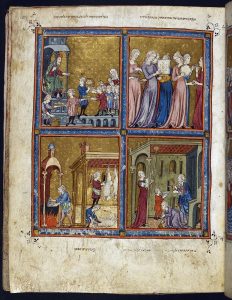
Miriam celebrates with the Hebrew women, and scenes of preparations for Passover
According to Jewish tradition, in Passover the past becomes present, especially during the narration of the liberation from Egypt, and what is experienced at that moment is a witness to what will continue to be made real in the future.
Passover is a “memorial” (zikkaron) of the past. In the Mishnah it speaks of the attitude with which one must participate in the Passover supper: “In every generation a person must regard himself as though he himself had gone forth from Egypt…” (Mishnah, Pesahim X, 5)
At the same time, that liberation of the people in the past gives strength to work for the building up of Israel in the present life and nourishes the hope of definitive liberation at the consummation of the ages. For this reason, in the time of Rabbi Akiba, this petition was added to the ritual: “May the Lord our God and the God of our fathers enable us to reach other Passovers and other festivals that come to meet us in good health, rejoicing in the rebuilding of the temple of your city and joyful in the restoration of your worship” (Mishnah, Pesahim X, 6).
In the early times after the Exile, the Passover banquet was celebrated as described in the book of Exodus: standing, in haste, as those ready for the journey. With the penetration of Hellenistic customs, it gradually took on a more festive character. In the time of Jesus, the participants reclined at table, the meal lasted several hours, and it conformed to a detailed ritual.
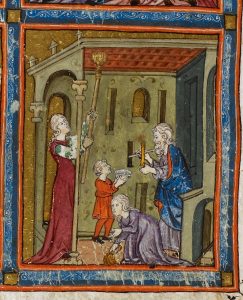
General house cleaning before Passover, Golden Haggadah, circa 1320.
On the night from the 13th to the 14th of Nisan, the bediqah (search) took place. The head of the household searched throughout the house and collected even the last crumb of leavened bread. That leavened bread could be eaten until right before noon on the 14th of Nisan, but at noon whatever remained had to be burned.
The lamb was prepared four days in advance (Ex 12:3). On the day of the Passover supper, it was carried on the shoulders to the Temple shortly after noon (if it was the Sabbath, tied with a rope). After the offering of the evening sacrifice, around half past two in the afternoon, the head of the household or his representative slaughtered it there, while a priest collected the blood in a golden or silver basin and then poured it upon the altar.
When slaughtering it and preparing it for the supper, none of its bones should be broken (Ex 12:46).
On the north side of the altar of holocausts there were hooks on the walls and columns where the lambs, already drained of blood, were hung to be skinned and gutted. The entrails, kidneys, liver, and fatty parts were taken to the altar of holocausts and burned. The cleansed lamb, wrapped in its skin, was carried home. There it was skewered on a branch of pomegranate wood and roasted over a charcoal fire.
In the 1st.Century the supper took place as follows:
At the beginning, a first cup of wine was distributed, which the head of the household offered with a blessing.
Next came the purification of the hands, washing them with water.
Then came the “bitter herbs” (maror). This could be, for example, a salad prepared with endives and radishes. Before partaking of them, the corresponding blessing was pronounced. When eating them, one could dip them lightly in haroset, a paste of fruits, nuts, wine, and spices, which softened the bitterness somewhat but was not to mask it entirely.
Then the roasted lamb was brought in, and the second cup was served. Without yet eating the lamb or drinking the wine in the cup, the decisive moment of the Passover Haggadah took place. It began with a family dialogue between the father and the children. One of the youngest asked: Mah nistanah ha-layla ha-zeh mi-kol ha-leylot? (Why is this night different from all others?)
During that dialogue it was pointed out that on this night, unlike all other nights, unleavened bread is eaten, bitter herbs are taken, the herbs are dipped twice, and the meat is eaten only roasted, not prepared in any other way.
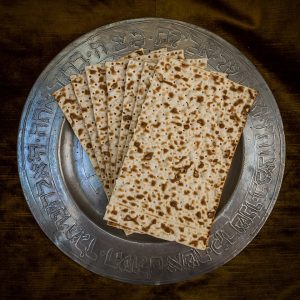
Matzot unleavened bread by Claude Truong-Ngoc
The answers to these questions provided the occasion to recount the liberation from Egypt in great detail, which formed a substantial part of the rite. The essential element is the remembrance or memorial of the exodus from Egypt. This narration was given by the father in the first person, as a testimony that it was not merely a matter of recalling a past event, but something that in some way became present in that ritual: “This is what the Lord did for me when I was brought out of Egypt…”
The narration was long and extensive. When it concluded, those present were invited to give thanks to God for the benefits received, and the first part of the Hallel was recited—a great hymn of praise (Psalms 113–114).
At that point the second cup was finally consumed.
Next, the head of the household blessed the unleavened breads (matzot) and distributed them to those present. Then he also blessed the lamb’s meat, and once blessed, the roasted lamb was eaten.
After clearing away the remnants and washing the hands, this part of the supper concluded with the serving of a third cup, or “cup of blessing,” which usually contained wine mixed with water. As previously, before drinking it, a long and solemn thanksgiving was recited.
The final part of the supper consisted of the Passover Hallel, a lengthy composition of thanksgiving that included Psalms 115, 116, 117, and 118, to which certain exclamations of jubilation, gratitude, and adoration were added over time.
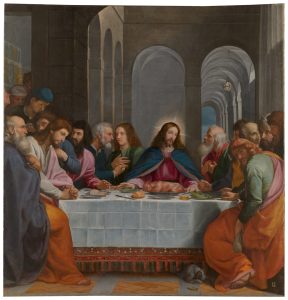
The Last Supper by Bartolomé Carducho. ©Photographic Archive Museo Nacional del Prado.
Thus the supper concluded with the hymns and acclamations of joy from one who has personally experienced the salvation of God. As in the text itself, when reciting Psalm 116:13, he invited all to “raise the cup of salvation and call upon the name of the Lord.” The supper ended with a fourth cup. Then the after-supper conversation could be extended, but not past midnight.
By don Francisco Varo, priest