
William Faulkner borrowed the title of his famous novel from King David’s cry of distress when he learned of the death of his rebellious son Absalom. For several centuries, the collective memory of this biblical passage has crystallized around a funerary monument in the Kidron Valley: the Monument or Pillar of Absalom—Yad Avshalom in Hebrew.
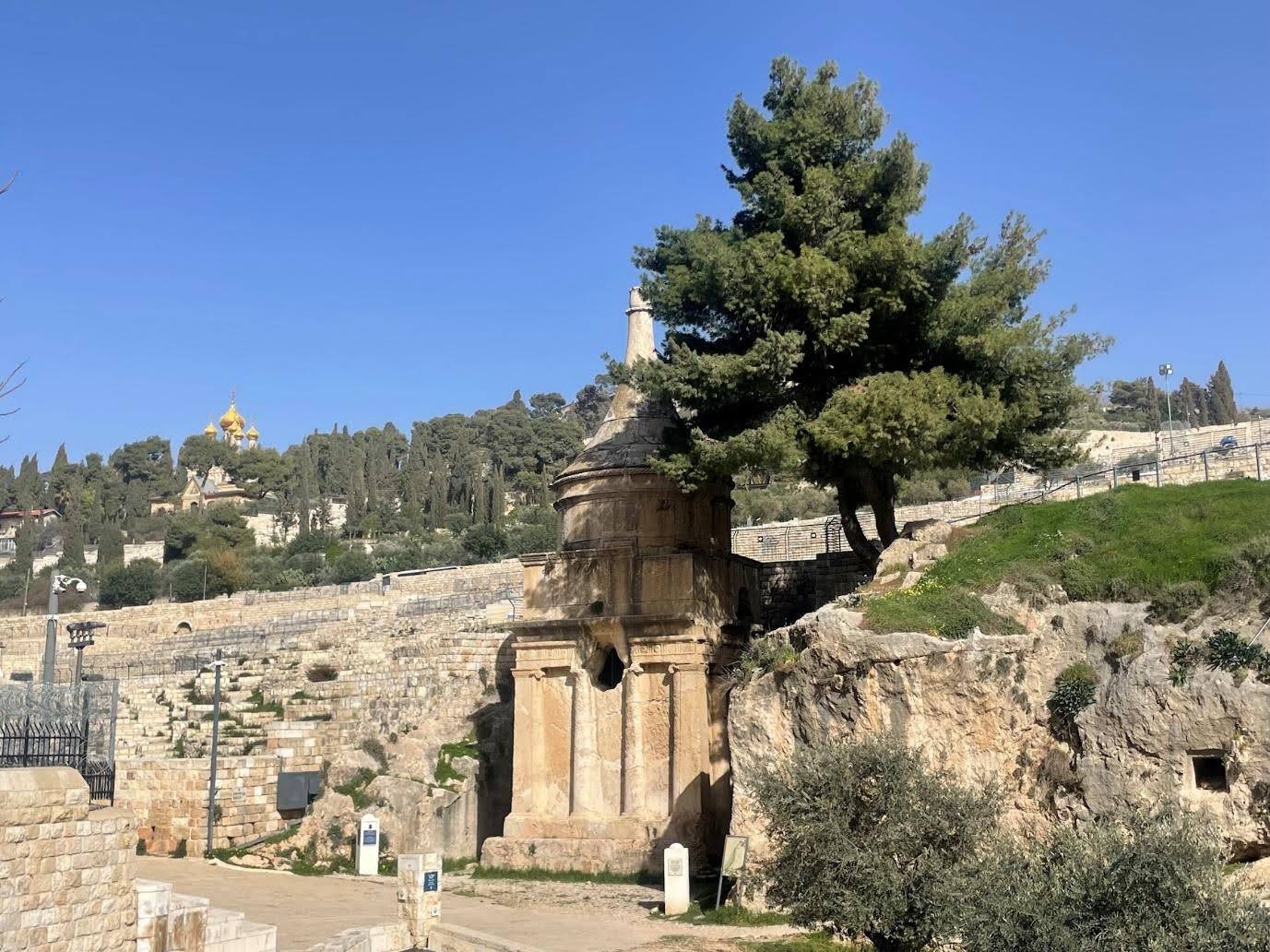
Absalom’ Pillar, in the Kidron Valley, on the western slope of the Mount of Olives by Henri Gourinard, 2026
Absalom ´s death
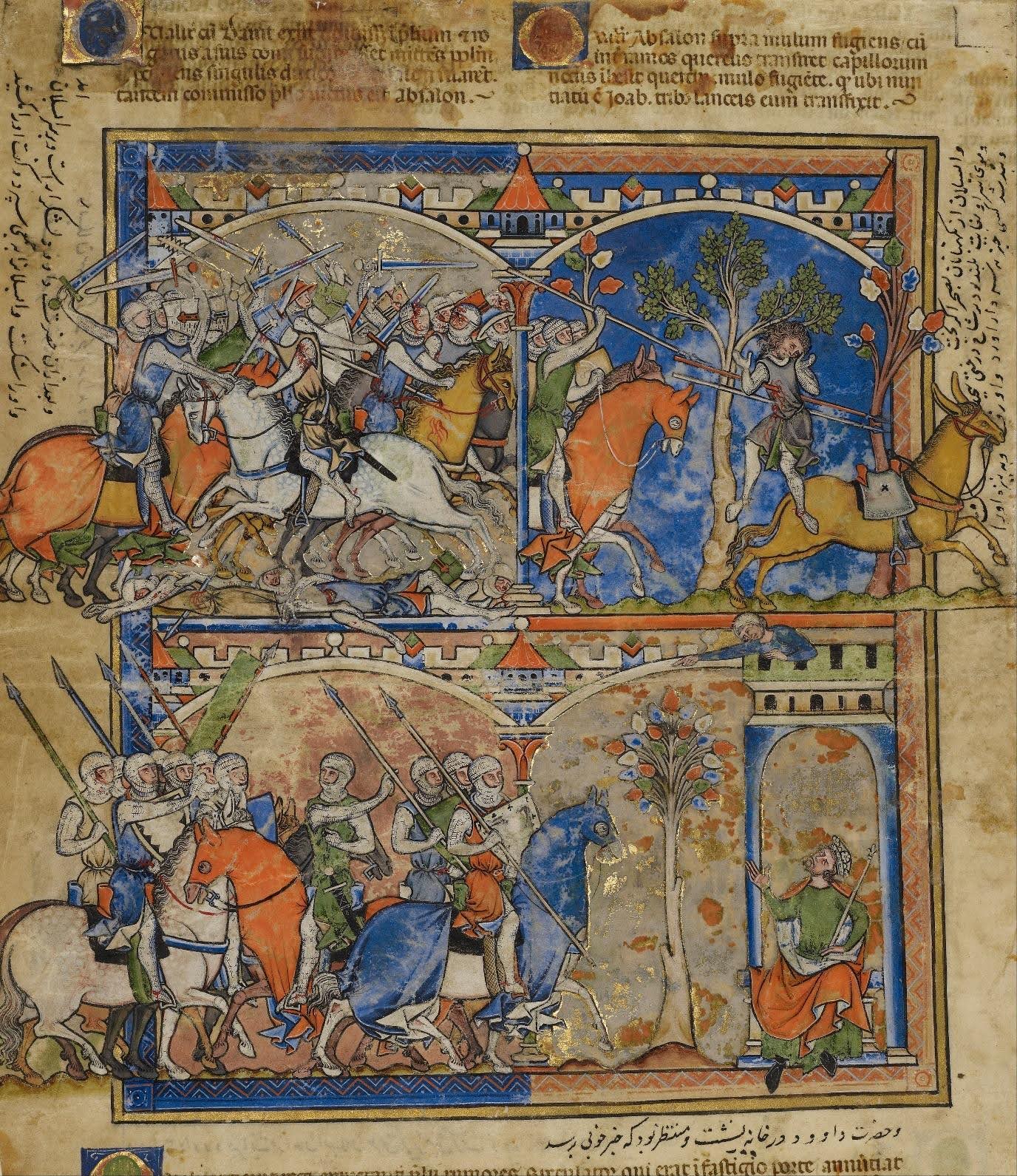
The biblical account is quite clear on this point (2 Sam 18:6-17): a battle between Israel (under Absalom’s command) and David’s servants took place in the forests of Ephraim—that is, in present-day Samaria, dozens of kilometers north of Jerusalem. David’s side had the upper hand. Absalom’s forces were routed. In the aftermath of the battle, Absalom met his death. As he was riding his mule, his long hair became entangled in the branches of a terebinth tree. The news was reported to Joab, one of David’s generals, who grabbed three stakes with which he pierced Absalom’s heart. Joab, then, sent a Cushite (Ethiopian) servant to announce the news to David. We know the story: as with Saul, David did not rejoice at the death of his enemy; as with Saul and Jonathan, David sang a lament.
Just before that, verse 18 seems to be an insertion. As an aside, the sacred author informs us that:
Now Absalom in his lifetime had taken and set up a [c]pillar for himself, which is in the King’s Valley. For he said, “I have no son to keep my name in remembrance.” He called the pillar after his own name. And to this day it is called Absalom’s Monument (NKJV).
It was therefore at Absalom’s presumed tomb in the “Valley of the King” (Kidron Valley) that, as Flavius Josephus reports (Antiquities, 7, 243), Jewish fathers used to take their disobedient sons to show them what fate awaited them if they did not mend their ways.
However, the “Absalom’s Pillar” from biblical times no longer existed when Josephus wrote (late 1st century AD). The monument on which Josephus’ passage is based is in fact the monolithic mausoleum of a very wealthy aristocrat from Jesus’ time Jerusalem. Its architectural style places it within the tradition of large Graeco-Roman funerary complexes (mausoleums and tombs) carved into the rock, the most famous of which are found in Petra. The base is a quadrilateral carved from the hard limestone of the Kidron Valley. A particularly elaborate cornice, topped by a masonry entablature, marks the transition to a round drum topped by a concave cone, known as a “Chinese hat.” A beautiful braid separates the drum from the cone.
Perhaps it is the tomb of a high priest or an aristocrat—some have suggested King Herod Agrippa (r. 41–44 AD). Indeed, adjacent to the imposing Absalom’s Pillar is the tomb and mausoleum of the priestly family of “Bene Hezir” – the sons of Hezir, a priestly family belonging to the 17th priestly course serving in the Jerusalem Temple during the First Temple period (see: 1 Chr 24:15; Neh 10:21) and probably also during the Second Temple Period. The names of its members are inscribed in Hebrew on the lintel of the distyle in ante that opened onto the burial chamber.
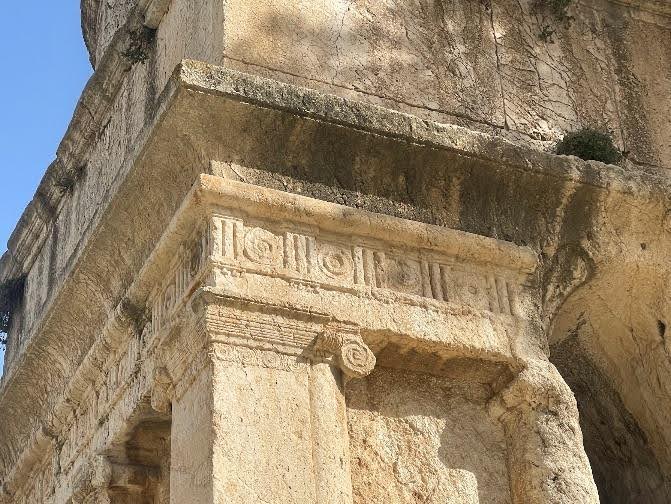
Ionic-style cornice of the Absalom’s Pillar by Henri Gourinard, 2026
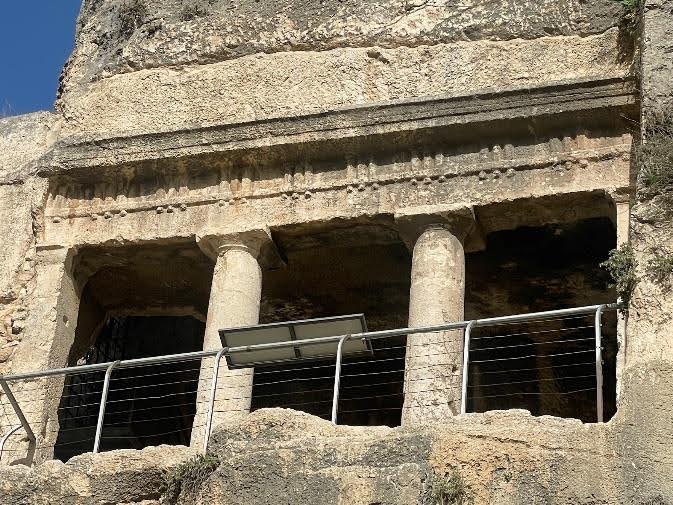
Lintel of the tomb of Bene Hezir by Henri Gouriinard, 2026
No inscription allowing for certain identification has been discovered on the so-called Absalom’s Tomb, leaving the door open to all kinds of speculation. Before being associated with David’s son, the famous monument was identified in turn as the tomb of King Hezekiah (Bordeaux’s pilgrim, 333 AD) or that of Zechariah, father of John the Baptist. An inscription carved on the south cornice, indeed, states in Greek: “This is the tomb of Zechariah, martyr, very pious priest, father of John.”
For some unknown reason, this tradition of Zechariah’s tomb has shifted to a third monument: a mausoleum quite similar in design to that of Absalom, but carved entirely out of rock and topped with a four-sided pyramid.
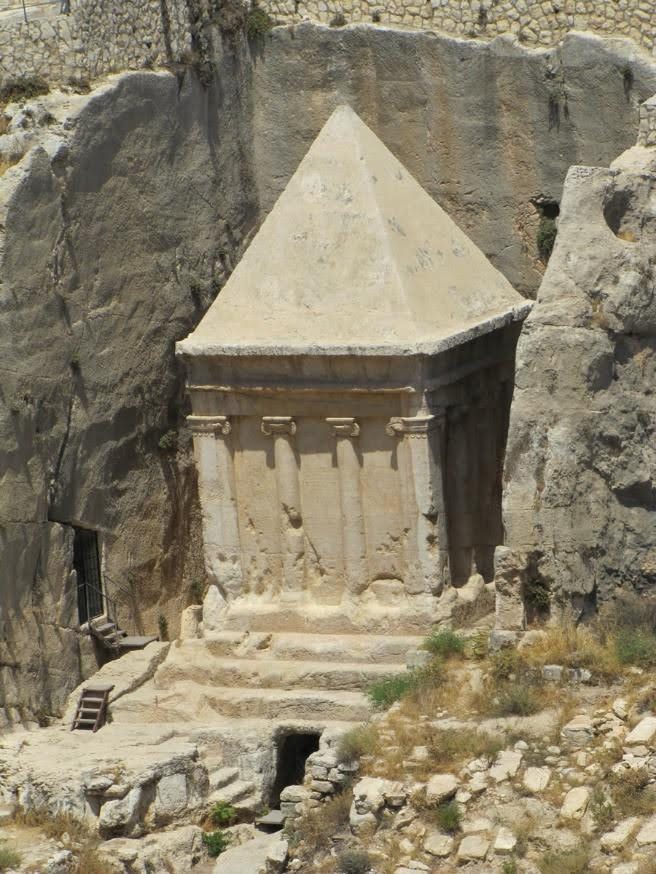
The monolithic mausoleum known as “Zechariah” by Henri Gourinard, 2013
Regardless of who was buried in these tombs, both the “Absalom’s Pillar” and the “Tomb of Zechariah” are the only intact monuments from the Herodian period in Jerusalem.
Jesus himself must have passed by them many times on his way to and from the Garden of Gethsemane.
By Henri Gourinard