
When Rome took power in Jerusalem, the land of Israel was a deeply Hellenized region, though some pockets of population still preserved their own religious and cultural identity with great vigor.
Pompey kept Hyrcanus II at the head of the Jewish state, deprived of the title of king but retaining that of high priest. The country was subjected to Rome, with the obligation to pay tribute. Pompey withdrew, taking many Jews as prisoners; later in time these formed the basis of the Roman diaspora.
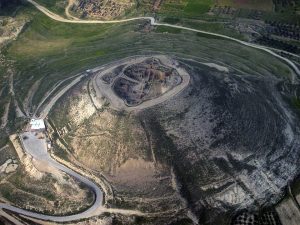
The Herodium from above by Asaf T.- Herod the Great
But when civil war broke out in Rome, the fate of Judea—like that of the rest of the Roman provinces—depended on the outcome of the conflict. After Pompey’s defeat at Pharsalus, Hyrcanus II and his faithful collaborator Antipater abandoned Pompey’s side and switched to Caesar’s. Caesar confirmed Hyrcanus II as priest and appointed him ethnarch of the people. Antipater was named governor of Judea, granted Roman citizenship, and exempted from taxes.
The Jewish state, bound by a treaty of friendship to Rome, gained a certain autonomy, though it remained obliged to pay tribute. Antipater took advantage of his position to have his sons Herod and Phasael appointed governors of Galilee and Jerusalem.
In the year 40 BC, the Parthians managed to take control of the entire Near East for a short time, and taking advantage of the confusion, Herod went to Rome to win the support of Mark Antony, who at that moment was one of the most powerful men in the City. Antony persuaded the Roman Senate to appoint Herod king of Judea at the end of 40 BC. Upon his return, with the support of Rome, he succeeded in conquering Jerusalem in the summer of 37 BC.
The reign of Herod (37–4 BC), is usually broken down into three periods. The first is the consolidation of power. The second is the time of prosperity and peak. And the third is characterized by family problems and succession struggles.
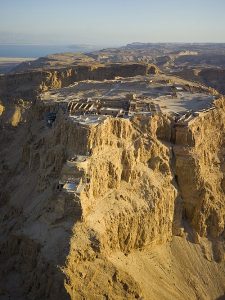
Masada aerial view by Godot13
Herod the Great´s Architectural Legacy
Herod was an outstanding promoter of construction projects. He built the city of Caesarea and endowed it with a magnificent harbor and all the elements that a great Hellenistic city would require, including a temple to Augustus. He also carried out an impressive reconstruction of Samaria, which he named Sebaste, the Greek name for Augustus, in his honor. He erected great fortresses: a Herodium in Moab and another in Tekoa, near Bethlehem; and he restored the existing ones: Machaerus and Masada, where he built splendid palaces.
In Jerusalem, during the time of Antony, the Antonia Fortress had been constructed at one corner of the Temple esplanade. Herod would later build a theater, an amphitheater, and a hippodrome, as well as a strongly defended, sumptuous palace in the upper city, remains of which are still preserved. But his crowning achievement was the reconstruction of the Temple, famous for its magnificence. The work began around 20 BC. The Temple proper was completed in a year and a half, and the outer courts in eight years, but the construction would not be finished until long after his death, in the year 62 AD.
How Herod the Great achieved stability in the country.
As regards political and religious organization, Herod radically transformed the Sanhedrin and the High Priesthood. The Herodian Sanhedrin, presided over by the king and composed of his counselors, was scarcely distinguishable from the private councils of Hellenistic monarchs. The office of high priest had until then been lifelong and hereditary; and was seen as a representative of the nation. To make it more manageable, Herod removed its lifelong and hereditary character and deprived it of any influence in the political sphere.
With his clear vision of political realities, his lack of scruples, and his decisive action as a loyal vassal of Rome, Herod provided the country with a long period of stability and peace and managed to preserve a remnant of national identity. Shortly after his death, Palestine would be fully integrated into the general system of Roman provinces.
By Francisco Varo, priest
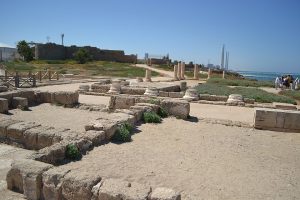
Caesarea Maritima: King Herod’s Palace by Larry Koester